Unrequited love
It Must Be Love: A Mustang Prairie RomanceUnrequited love is the emotional condition that first separates Trixie Beaumont from Jack Thorpe and later keeps their adult intimacy unstable. It begins as a girl’s devotion to an older boy who does not see her clearly, survives the humiliation of watching him choose Marissa Thorpe, and returns as an adult attachment complicated by sex, grief, and Jack’s fear of loving again. Its decisive significance is that Trixie’s love is never merely passive longing: it teaches her to withdraw, build a livelihood, demand emotional honesty, and reject any relationship whose future depends on her accepting second place to a ghost.
Childhood Devotion and Its Wound
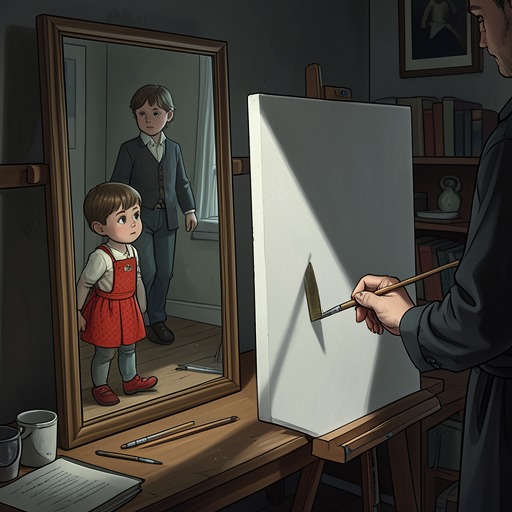
Nina Thorpe’s recollections establish that Trixie’s feelings for Jack began long before their adult relationship. As a girl, Trixie was deeply in love with him, followed him wherever she could without intruding, and remained close enough to watch and hear him. Her affection was visible in the sad smiles she sent from a distance. Jack, absorbed in Marissa, failed to recognize what was happening. When he returned to school after Thanksgiving, Trixie cried so intensely that Nina remembered the heartbreak years later; Jack’s mother insists that the reality of that pain was not diminished by Trixie’s youth.
Jack eventually came home with Marissa, and the effect on Trixie was immediate and lasting. She stopped appearing wherever the couple was, becoming, in Nina’s description, almost a little ghost herself. Jack interpreted her absence as ordinary teenage independence, but Nina explains that Trixie was deliberately avoiding the happy couple. The irony is central to the state of unrequited love: Trixie’s withdrawal makes her feelings less visible just when they are most intense, while Jack’s failure to understand her silence protects him from recognizing how thoroughly he has hurt her.
Nina later urges Jack to tell Trixie the truth about his marriage and about the tension between them. She identifies the dead Marissa as a continuing rival—not a living competitor, but a ghost whose idealized presence makes Trixie’s position impossible. Jack’s mother understands that Trixie cannot resolve the relationship while Jack refuses to explain why he will not love again. The past therefore remains active in the present, not because Trixie is unable to mature, but because Jack’s withheld history leaves her to compete with an image she cannot question or defeat.
Adult Recurrence and the Pursuit-Withdrawal Pattern
In adulthood, Trixie’s old attachment returns within a relationship that Jack treats as pleasurable but undefined. After their first sexual encounter, Jack tells her that the night was wonderful but that he cannot make promises because his life is full and chaotic. His uncertainty confirms the fear beneath Trixie’s desire: physical closeness does not necessarily mean emotional availability. She responds not with an open confrontation but with restraint, allowing his daughters to greet her warmly while she absorbs the force of his refusal.
Trixie later tells Sadie that she and Jack have hooked up several times, but that is all. She believes he is still in love with his wife and does not want anything serious. Her conclusion is not based on a single disappointment; it grows from a repeated pattern of intimacy followed by distance, including Jack leaving her bed after the Halloween party. Trixie knows that she has never been offered a secure future, yet the knowledge does not make the attachment disappear. Instead, it turns love into a problem of self-command: she must keep wanting him while trying to prevent that desire from governing her choices.
Her refusal to remain in an undefined arrangement is precise. She does not claim to be seeking marriage immediately, particularly after her own failed marriage, but she insists on retaining the possibility of something serious. She will not waste time in a relationship with no hope of a future, and she rejects the idea that sexual satisfaction can compensate for emotional abandonment. Her position converts unrequited love into a boundary: she can desire Jack without consenting to be an interim companion in the life he has organized around grief.
Jack, meanwhile, experiences her withdrawal as avoidance. At Thanksgiving, Trixie arrives only ten minutes before the meal, saying that she lost track of time. Jack does not believe her and realizes that she has stayed away from his house, even while he continues hearing about her through Jonquil and the girls. The holiday gathering makes the contrast visible: his home is full of parents, friends, children, food, and inherited traditions, but Trixie keeps herself at its edge. Her absence is both protection and punishment, a way of preserving her independence while forcing Jack to feel the distance he helped create.
Self-Protection Through Work and Creation
Trixie’s response to emotional uncertainty is inseparable from her effort to build a stable life. For months she has considered creating her own clothing line, experimenting with names, sketching logos, and even hiring a graphic designer to make the designs real. The completed logos begin to taunt her because they represent a dream she has not yet acted upon. This hesitation resembles her romantic situation: the future is imaginable, but imagination alone cannot make it secure.
She breaks through that inaction by dressing deliberately in a red polka-dot dress, red heels, a sweater, and a black beaded handbag, then walking from her apartment above Under the Skirt Online across the street to City Hall. She seeks official approval from Eric, the interim mayor, for what she intends to create. The scene gives her longing a counterpoint in purposeful movement. Instead of waiting for Jack to decide what she means to him, Trixie goes to the person who can authorize the next step in her own enterprise.
The line becomes Sexy Separates by Trixie. While folding panties for a new display table, she develops a concrete range: six to ten styles, from g-strings to bikini and French-cut designs, in silk, lace, and cotton, with a possible boy-cut option. A rainbow theme will accommodate vibrant colors, while four bra styles—including a convertible bra—will allow women to mix and match. Her friend Sadie’s habit of combining colors in the lingerie drawer helps confirm the concept. The brand’s design principle is therefore practical and expressive at once: intimacy need not be packaged as a single prescribed set.
Trixie’s business also supplies the stability her parents never consistently modeled. She loves them, but their lives have moved from hobby to hobby, interest to interest, religion to religion, and finally toward Oregon, while she now seeks obligation, responsibility, and dependable income. After several straight months of profit, Under the Skirt Online is officially open, and she imagines renting the neighboring space as both warehouse and workspace, perhaps hiring a part-time employee earlier than planned. Her entrepreneurial ambition is not a decorative subplot; it is the material structure that lets her survive desire without surrendering her future to it.
The Launch, the Gift, and the Cost of Hope
The launch of Sexy Separates by Trixie gives her an achievement Jack cannot define for her. At Dylan’s bar, a makeshift runway divides the room, with music from Sadie and Kiki Ramirez creating the show’s soundtrack. Sadie models teal boy shorts and a matching Basque, then a white cheeky set with a matching bra, a silky duster with silver buttons, and cherry-red stilettos. Trixie watches the lighting, music, gauzy fabric, movement, and applause turn her designs into a public reality. The new tagline is “Sexy and fun,” and the show is an artistic and commercial success.
Yet the triumph carries an emotional absence. Trixie walks the runway with the models, receives congratulations, and feels satisfied because the line is officially launched. She has done what she set out to do, but she has no one, not really, with whom to share the victory. The sentence does not cancel her accomplishment; it shows the residual power of unrequited love. Independence has given her success, control, and a visible future, but it has not removed the wish that Jack might stand inside that future with her.
That wish becomes painfully tangible at Christmas. Jonquil Spring gives Trixie a snowflake-wrapped present from Jack. Trixie has bought him a gift as well, ostensibly as a friend, but admits that his face, laugh, and physical presence are never far from her thoughts. She knows that opening his present may strengthen the love she is trying to pound into submission. When she finally unwraps it, she discovers Blue Skies, her favorite painting, and the original work rather than a reproduction. The gift is intimate enough to revive hope precisely because Jack has still not been clear about what he feels.
The immediate consequence is not relief but renewed entrapment: Trixie realizes that she may never get over him. Her response reveals why the relationship cannot be reduced to casual sex. Objects, memories, and artistic attention give Jack access to the emotional center she is trying to defend. At the same Christmas gathering, Andie Thorpe tells Jack that apologizing is what a boy should do after hurting a girl’s feelings and directly urges him to apologize to Trixie, saying that she and Abby Thorpe know he likes her. The children thus become witnesses and catalysts, bringing the adults’ evasions into the family’s open space.
Truth, Recognition, and Transformation
Jack’s eventual disclosure changes the meaning of Trixie’s earlier rejection. He explains that his marriage to Marissa became tense after his art career took off, that she resented his success and the attention, admiration, and press directed toward him, and that they were close to divorce when she died. They had been arguing when Marissa left, accusing him of making her take care of the children alone. She suffered an aneurysm behind the wheel and died before the car struck a tree, while the public continued to believe the simpler story of a fortunate marriage ended by an accident.
This confession identifies the true obstacle behind Jack’s apparent unavailability. He is not simply preserving a perfect love; he is trapped in grief, marital bitterness, guilt, and the fear that any future marriage would reproduce the damage of the first. By telling Trixie what he had withheld, he gives her a reality more complicated than the ghost she had been competing with. The disclosure does not erase the pain caused by his indecision, but it replaces conjecture with knowledge and makes emotional honesty possible.
The decisive reversal comes when Jack distinguishes his former marriage from his present relationship with Trixie. He says that the only love he knew before was an immature kind of love, whereas what he has with Trixie is comfortable and thrilling, fun and sexy; because he did not recognize that form of love, he was slow to understand it. When Trixie asks whether he loves her, he answers directly that he does. Her hope remains wary rather than unquestioning, but the answer ends the original structure of the relationship. Unrequited love has not been solved by Trixie wanting less. It changes because Jack finally names what he feels, accepts responsibility for the truth he concealed, and meets the emotional risk that Trixie has been carrying alone.
The state therefore marks the movement from one-sided childhood devotion toward reciprocal adult love. It shapes Trixie’s attachment through repeated pursuit and withdrawal, but it also produces her insistence on independence, her refusal to compete with a dead woman, and her demand for a relationship with an actual future. Her creative work gives that demand a material form, while Jack’s confession supplies the recognition it could not provide by itself. The eventual declaration of love does not make the earlier longing irrelevant; it reveals how much self-knowledge, boundary-setting, and truth-telling were required before longing could become a shared relationship.